
Candidate List grows to 253: n-hexane and Bisphenol AF added
Two new entries trigger Article 33 and SCIP duties for articles above 0.1 % w/w. Solvents, adhesives and fluoropolymer supply chains are most exposed.
Read the update →Upload a Safety Data Sheet or declare your substances. Verachek screens every substance against 13 EU lists, including REACH SVHC and Annex XVII, RoHS, POPs, PFAS and the Battery Regulation, and returns a RED / AMBER / GREEN verdict you can file.
or declare several substances · upload a Safety Data Sheet · see how screening works
Free, no account needed. A real verdict on your own product; the full report comes with a paid report or plan.

If you place articles or mixtures on the EU market you carry REACH, RoHS and POPs obligations. The Candidate List changes twice a year. Until now the options were an enterprise suite, a consultant's day rate, or a spreadsheet.
Built for supplier-declaration campaigns across thousands of parts. Months to implement, priced for a procurement cycle.
Trusted, but slow and expensive for a single question, and you wait in their queue every time the list changes.
Upload or declare, get a verdict you can file, re-screen in one click when the rules change. From €0, no setup.
Upload a Safety Data Sheet, or declare substances by name, CAS or EC number and concentration. No SDS is needed for a declared check.
Each one is matched by CAS against 13 EU lists, with the entry's own concentration limit, group sum-rules and category derogations applied.
A RED, AMBER or GREEN verdict per substance and overall, with Article 33 text, phase-out dates and safer alternatives. RED results are reviewed by an engineer before you see them.
Declare substances, upload a Safety Data Sheet, or see how your products are kept on file. Each view runs on sample data, so you can try it before you send anything.
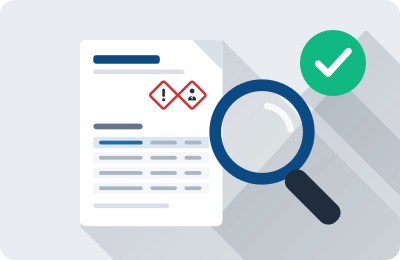 01 · Declared substancesType what you knowName, CAS, EC and concentration. No SDS needed. See how odd formats and missing data are read.Open the view
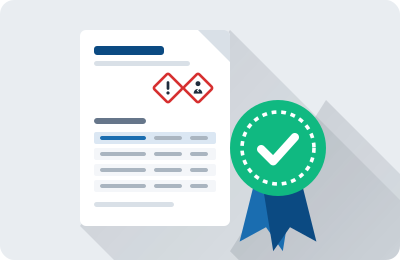 02 · SDS uploadUpload a Safety Data SheetSection 3 is extracted row by row, including two-part sheets, missing EC columns and scanned PDFs.Open the view
 03 · Product workspaceKeep every product on fileVerdicts, regulatory updates and supplier declarations together, re-screened when the rules change.Open the view
If you manufacture, import, distribute or brand it for the EU market, we screen it against the lists that apply to your category, with the Annex XVII conditions and exemptions that go with it.

Consumer electronics, components, lighting, appliances, IT hardware.

Toys, teethers, feeding, prams, textiles for under-3s.
Apparel, workwear, shoes, bags, upholstery, technical textiles.

Formulated products, resins, two-component systems, inks, cleaners.
Cells, packs, power tools, e-mobility, portable devices.

Plastics, coatings, closures, printed packaging.

Seals, hoses, fasteners, castings, fluoropolymer components.

Furniture, sports gear, DIY, jewellery, cosmetics accessories.

You inherit your suppliers' obligations. Screen before you list.
Screen on behalf of clients, white-label, pooled volume.
Verachek is run like a compliance function, not a lookup tool. These are the rules it works to on every screening, for every client.
Every list is compiled from the official EU legal texts and their published updates, versioned and dated. Nothing is inferred or invented.
Each hit cites the list entry and the knowledge-base version it rests on, so any past result can be reproduced.
A materials and product-compliance engineer maintains the lists and checks every RED result before it is released.
Missing concentrations and unreadable pages are flagged for attention. An unclear result is never shown as GREEN.
Processing under the GDPR with a Data Processing Agreement, isolated client workspaces and deletion on request.
Verachek informs your compliance decision. You remain the duty-holder under REACH and RoHS, and every report says so.
The Candidate List gets the headlines, but Annex XVII is where products get stopped at the border. Its 70-plus entries don't share a single limit: each carries its own concentration threshold, article scope, exemptions and dates. Verachek applies them the way an enforcement lab reads them.
Regulatory hits by list, concentration verdicts, group sum-rules (phthalates, PFAS) and category derogations applied. The highest-risk cases are checked by a compliance engineer before release.
An Article 33 communication generated when an SVHC is at or above 0.1 %, a dated phase-out timeline for authorisation and sunset dates, and safer-substitution options, each with its own shareable link.
A clean CSV of every substance and its status, plus every screening logged with the knowledge-base version used, so a past verdict can always be explained.
Supplier declarations that came back incomplete, a bill of materials with thousands of parts, a PFAS inventory before the restriction, a material that must be replaced. The engineer behind Verachek takes these on as scoped assessments with a written deliverable.
| Input | ERP export, 3,200 parts across 14 products; 140 supplier declarations of mixed quality |
| Work | Normalise, screen every part against 13 lists, reconcile declarations, rank gaps |
| Output | Per-part verdict dataset, 14 product roll-ups, supplier chase list, Article 33 texts, written assessment |
| Timeline | Scoped within two working days; delivered in three weeks |
Illustrative scope, not a customer case.
No enterprise contract, no onboarding project. Prices are published because you should be able to decide without a sales call.
No. Verachek is an automated screening aid built and reviewed by a materials and product-compliance engineer. It informs your decision; you remain the legal duty-holder under REACH, RoHS and the other regulations. Every report says so.
Every hit cites the list entry it rests on, so you can check it against the official source. Missing concentrations and unreadable SDS pages are flagged instead of guessed, an unclear result is never shown as GREEN, and every RED verdict is reviewed by an engineer before release.
Thirteen EU lists, including the REACH SVHC Candidate List, Annex XIV and Annex XVII, RoHS Annex II, the POPs Regulation, PFAS restrictions and the Battery Regulation. The full list, with how each one is screened, is on the Regulations page. Scope is EU/EEA at launch.
A real screening of one product, either declared substances or one SDS, with the RED / AMBER / GREEN verdict and hits by list, sent by email. No account and no card. The full report with Article 33 text, phase-out dates and alternatives comes with a paid report from €29 or a plan.
It is used only to produce your verdict and is stored in an isolated workspace. Free-check submissions are deleted after 90 days unless you open an account, and any file is deleted on request. Details are in the Privacy Policy.
AMBER and GREEN results are sent as soon as the screening is complete. RED results are checked by a compliance engineer before release, so they follow once that review is done.
Yes. Bulk BoM and bill-of-substances screening is quoted per job: one setup fee plus a price per line that falls as the volume grows, confirmed in writing before any work starts. See bulk screening.
Not for the free check. Reports and plans are arranged by email, and the client workspace is set up for your team on request. See Client access.
Two new entries trigger Article 33 and SCIP duties for articles above 0.1 % w/w. Solvents, adhesives and fluoropolymer supply chains are most exposed.
Read the update →RAC's opinion and SEAC's draft opinion landed in March 2026; consultation closed in May. What a time-limited-derogation model means for your products.
Read the guide →The 0.1 % rule, the "once an article, always an article" principle, and what a compliant communication actually has to say.
Read the guide →